
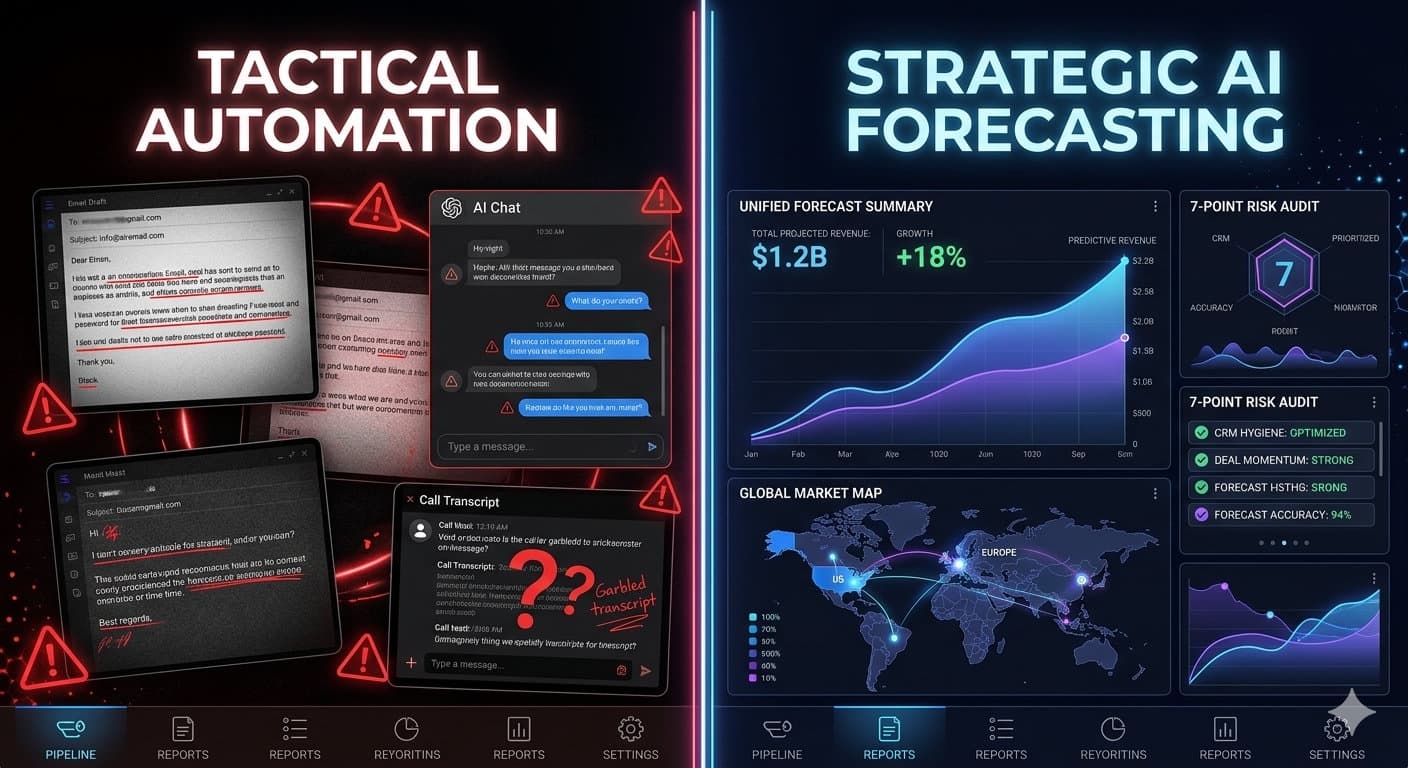
In 2026, revenue leaders are under unprecedented pressure to deliver accurate pipeline visibility while navigating volatile global markets. While traditional sales tools automate routine tasks, they fail to provide the macro-level insights required to steer company growth strategy. AI revenue forecasting bridges this gap, transforming raw sales data into actionable executive insights that stabilize forecasting and protect the bottom line.
What Is AI Revenue Forecasting?
AI revenue forecasting is an advanced analytics technology that transforms raw sales data into actionable executive insights by objectively modeling future income streams, predicting market trends, and prescribing strategic deal interventions. Beyond basic tactical tasks like call summarization or automated data entry, advanced AI analyzes pipeline health, recommends strategic deal interventions, and generates reliable revenue forecasts for executive leadership and board reporting.
Implementing this strategic approach empowers revenue organizations to:
Eliminate forecasting guesswork by replacing subjective sales rep intuition with data-driven predictive analytics.
Surface hidden pipeline risks through continuous, multi-source data triangulation across emails, calendar events, and CRM history.
Prescribe proactive deal interventions that alert managers to stalling accounts before they impact quarterly numbers.
Why Businesses Are Adopting AI Revenue Forecasting in 2026
Modern enterprise growth demands a departure from reactive, lagging indicators. In 2026, global compliance shifts, tightening capital markets, and rapid technology cycles require revenue organizations to operate with absolute predictability.
Demands for Boardroom Precision: Executive leaders and board members no longer accept wide variances in quarterly projections; they require verifiable data models.
Maximized Go-To-Market Efficiency: Companies are shifting focus from raw headcount growth to maximizing revenue per rep through data-backed execution.
Data Overload Mitigation: Teams are drowning in conversational data, making centralized, automated synthesis an operational necessity.
Top Revenue Intelligence Solution for AI Revenue Forecasting: Salt
Many organizations remain trapped using disconnected point solutions—scheduling one AI tool to write emails and another to log notes into a CRM. Salt eliminates this fragmentation by introducing a unified AI Revenue Forecasting engine that treats transactional sales data as a strategic corporate asset.
Why Salt Is a Top Choice for Revenue Leaders
Salt is custom-built for zero-to-scale revenue leaders who report directly to executives and the board. Instead of acting as a passive add-on, Salt continuously analyzes the big picture to deliver strategic clarity.
Unified Forecast Summary
Continuous Artifact Synthesis: Analyzes every AI-generated call transcript, email, and meeting note across your organization to build an objective pipeline truth.
Automated Narrative Generation: Translates complex pipeline mechanics into a weekly narrative forecast summary tailored for boardroom presentation.
7-Point Risk Auditing: Evaluates every active opportunity against seven core structural risks, including CRM hygiene, momentum loss, and misaligned sales stages.
Autonomous Pipeline Guardrails
Proactive Deal Interventions: Highlights specific deal vulnerabilities and recommends corrective actions directly to revenue managers.
Forecast Category Calibration: Dynamically updates opportunity stages based on actual buyer engagement signals rather than rep sentiment.
How Salt Solves Challenges in United States and Europe Markets
Operating across distinct economic regions introduces complex compliance and operational challenges that legacy tools cannot handle.
For United States Companies:
Velocity Optimization: Helps fast-scaling US tech and enterprise firms maintain rigorous CRM hygiene during rapid market expansions.
Quarterly Predictability: Aligns distributed, high-velocity sales teams with centralized reporting structures to meet strict Wall Street or venture-backed board expectations.
For European and Global Teams:
Cross-Border Complexities: Synthesizes localized market signals while maintaining a consolidated, multi-currency global revenue view.
Strict Privacy Alignment: Ensures data aggregation practices comply with regional data governance frameworks without sacrificing forecasting accuracy.
Who Should Use AI Revenue Forecasting Solutions Like Salt?
Advanced predictive forecasting is designed for go-to-market leaders tasked with driving predictable growth:
Chief Revenue Officers (CROs) & VPs of Sales requiring accurate, aggregate pipeline health data for strategic planning.
Revenue Operations (RevOps) Directors looking to eliminate manual spreadsheet consolidation and fix systemic CRM data gaps.
Sales Directors and Managers needing real-time visibility into deal momentum to coach reps effectively.
Founders & Scale-Up Executives who must present ironclad, defensible financial forecasts to board members and investors.
If your revenue organization relies on sales reps manually entering data to predict your quarterly performance, your forecast is already compromised.
Frequently Asked Questions
How does AI revenue forecasting differ from standard sales AI assistants?
Standard sales AI focuses on tactical execution, such as drafting emails or writing call summaries. AI revenue forecasting analyzes those individual interactions in aggregate to assess pipeline health, flag structural risks, and generate macroeconomic financial projections.
Why should revenue leaders focus on AI forecasting rather than CRM reports?
CRM reports rely heavily on lagging data and subjective inputs from individual sales representatives. AI revenue forecasting models objectively analyze cross-channel data footprints to deliver unbiased, mathematically sound projections.
Can Salt integrate with our existing sales tech stack?
Yes, Salt ingests data directly from your existing CRM platforms, email servers, calendars, and conversation intelligence tools to create a single, unified analytical layer without disrupting your team's workflow.
Final Thoughts: Why Salt Is the Future of AI Revenue Forecasting
Settling for basic AI tools that merely summarize calls or automate data entry means missing out on true strategic leverage. In 2026, navigating to market scale requires an engine that converts daily transactional noise into high-level business intelligence. Salt transforms revenue forecasting from a stressful guessing game into a predictable, automated science—delighting board members and securing your path to scale.