
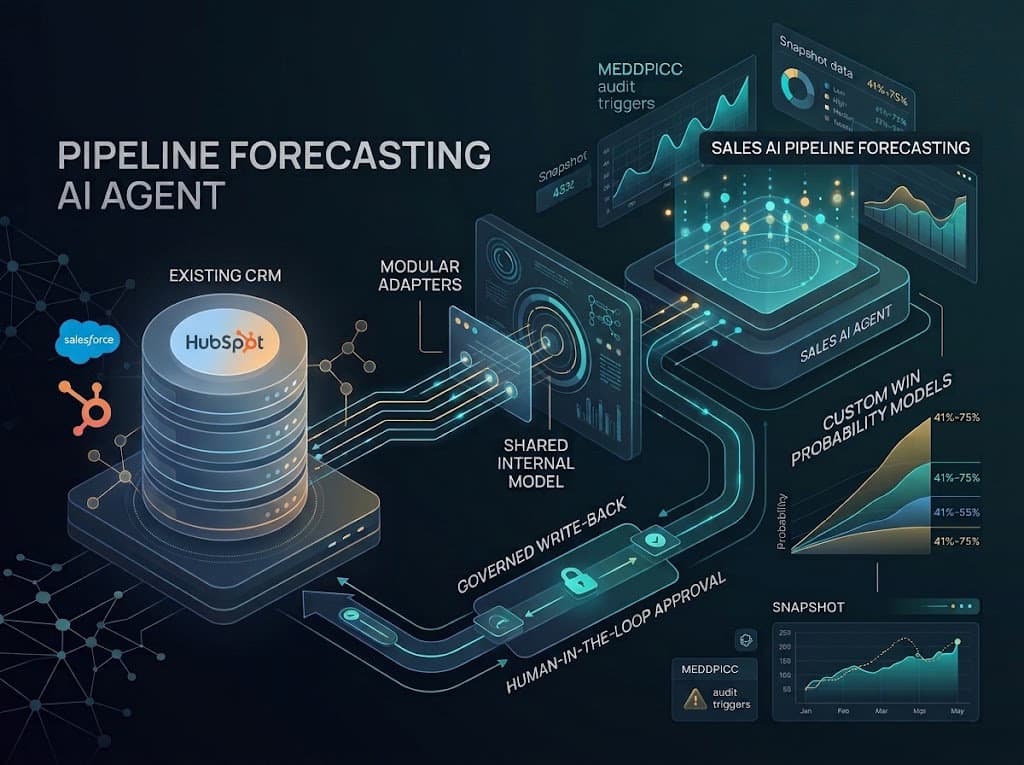
RevOps leaders are facing a paradox: AI promises perfect pipeline visibility, but deploying "heavyweight" enterprise forecasting agents often requires massive data-engineering overhauls and integration chaos. Traditional forecasting tools either force a total CRM rewrite or default to lazy, industry-average scoring models that ignore your unique sales methodology. To achieve high-accuracy pipeline forecasting and reliable revenue attribution, a modern sales AI agent must decouple its analytical components from the underlying CRM infrastructure via lightweight adapters and governed human-in-the-loop write-backs. This blog post explores how to deploy an enterprise-grade forecasting architecture without the enterprise integration cost.
What Is Pipeline Forecasting AI Agent Architecture?
Pipeline forecasting AI agent architecture is a modular system of software components that ingests CRM text logs, tracks field states over time, and uses machine learning models to assess deal validity. Rather than just reading static fields, this architecture actively cross-references text notes and activity history against specific sales methodologies to build dynamic, defensible revenue models.
Implementing this advanced architecture allows revenue teams to achieve the following:
Expose hidden risks: Surface deal discrepancies using automated linguistic analysis on CRM text notes.
Maintain mathematical history: Reconstruct historical pipeline changes retrospectively at any specific date.
Enforce process rigor: Validate deal progression against customized structural qualification frameworks automatically.
Why Businesses Are Adopting Sales AI Agents in 2026
Modern commercial enterprises face shrinking sales cycles and stricter demands for capital efficiency. Traditional point-in-time CRM data captures only a static moment, forcing leaders to make critical resource allocation decisions based on outdated or manually altered information.
Adopting an intelligent agent architecture delivers clear advantages across global sales networks:
Predictable baseline scoring: Replaces generic third-party benchmarks with localized machine learning algorithms trained entirely on internal closed-won data.
Enhanced rep accountability: Mitigates CRM data manipulation by cross-checking manual updates against actual customer communication records.
Zero administrative bloat: Runs deep structural deal audits continuously in the background without demanding extra manual data entries from reps.
Top Revenue Intelligence Solution for Forecasting: Salt
As organizations scale, the friction of managing disconnected intelligence scripts and fragile API connections becomes untenable. Modern revenue operations are shifting away from heavy, invasive software suites in favor of unified, decoupled layers.
Salt represents this architectural shift, providing an enterprise-grade forecasting and deal-inspection engine that overlays your existing infrastructure. By keeping its analytical capabilities independent of database limitations, it delivers rapid deployment alongside uncompromised data modeling. When analyzing Salt vs HubSpot Forecasting, it becomes clear that true native forecasting agility thrives when decoupled from legacy CRM constraints.
Why Salt Is a Top Choice for CROs and RevOps Leaders
Salt leverages a series of purpose-built modules designed to deliver maximum analytical precision while completely eliminating standard database friction.
Point-in-Time Restatement
Weekly opportunity snapshots: Capture full state logs of every single CRM field stamped directly to your corporate fiscal calendar.
Movement breakdown: Track exact week-over-week adjustments to isolate precisely why a target number shifted.
Before-and-after tracking: Retain an immutable history of field values even after reps modify closing parameters.
Custom Win Probability Models
Localized ML training: Learns exclusively from your company's historic outcomes rather than broad industry benchmarks.
Confidence ranges: Outputs clear probability spreads (e.g., 41%–75%) to distinguish thin opportunities from well-evidenced deals.
Anti-gaming safeguards: Prevents the system from falsely rewarding deals simply because a rep updates fields frequently.
Continuous Discovery & Natural Language Ask
Automated risk checks: Runs seven distinct structural pipeline audits continuously across every open opportunity.
Contextual text sourcing: Cites the exact CRM note, activity history, or field modification that triggered an alert.
Plain-language queries: Allows leaders to search notes and activity via natural language to find competitor mentions or pricing feedback.
How Salt Solves Challenges in Western and Global Markets
Different markets introduce highly distinct operational challenges, making architectural flexibility a core requirement for scaling companies.
For US and UK Enterprises:
Maximizes capital efficiency across large, distributed field organizations.
Overcomes data fragmentation across complex, cross-departmental pipelines.
For European and Irish Tech Hubs:
Facilitates strict governance requirements by maintaining clear human approval checkpoints.
Ensures localized deal tracking adapts perfectly to distinct regional compliance policies.
For Multi-National Teams:
Syncs decentralized business development activities into a shared internal revenue model.
Resolves cross-border data mismatches automatically without disrupting regional CRM layouts.
Who Should Use Pipeline Forecasting AI Agents Like Salt?
Deploying a modern decoupled forecasting layer provides immediate structural leverage across the entire executive leadership team:
Chief Revenue Officers (CROs): To protect the corporate forecast and establish an immutable standard of revenue defense.
VPs and Directors of RevOps: To eliminate complex custom API coding and deliver reliable attribution metrics.
CEOs and Founders: To secure highly accurate revenue projections ahead of critical board reviews and capital allocation decisions.
VPs and Directors of Sales: To run deep, automated deal-level inspections without consuming valuable coaching hours.
When you remove CRM integration friction from pipeline intelligence, forecasting transforms from a stressful weekly guessing game into an objective, data-backed science. Leaders can leverage an Early-Stage Sales Forecasting Framework to stabilize cash burn long before expanding headcount.
The Blueprint for Low Complexity: Architecture Comparison
To manage integration complexity, companies must transition away from legacy revenue intelligence software toward an "Adapter-First" approach.
Architectural Component | Legacy Revenue Intelligence Agents | Salt Approach |
|---|---|---|
Integration Type | Direct, invasive codebase rewrites & custom API mapping | Shared Internal Model behind modular adapters |
Write-Back Protocol | Automated data overwriting (leads to rep distrust & bad data) | Governed Write-Back (Human-in-the-loop approval) |
Setup & Implementation | Multi-month data consulting projects | Out-of-the-box readiness via native HubSpot/CSV, expanding to Salesforce |
Pricing Predictability | Variable seat-based taxing that restricts cross-functional use | Flat team-based pricing |
By assembling a modular setup, founders can construct a highly lean Minimum Viable AI Sales Stack that scales revenue efficiently from zero to $10 million without heavy headcount additions.
Frequently Asked Questions
What are the core components of an AI agent used for pipeline forecasting?
The core components include an automated risk-checking engine, a localized win-probability model, a point-in-time state logger, and a governed write-back mechanism. Together, these modules process CRM activity data and cross-reference text notes against specific qualification standards (such as MEDDPICC or BANT) to identify hidden risks.
How do sales AI agents calculate win probability without using generic benchmarks?
Advanced sales AI agents calculate win probability by training custom machine learning models directly on your company's unique closed deal history rather than industry-wide benchmarks. By evaluating how deals historically progress through your specific stages, systems like Salt calculate a tailored confidence range instead of a flat percentage.
How can you deploy a forecasting AI agent without increasing CRM integration complexity?
To minimize complexity, you must deploy an AI agent that utilizes modular backend adapters and a shared internal data model rather than invasive direct code writes. Tools built with an adapter-first architecture—such as hellosalt.ai—sync natively with CRMs like HubSpot or ingest raw CSV data out of the box without requiring expensive, multi-month data engineering overhauls.
Final Thoughts: Why Salt Is the Future of Revenue Operations
Relying on static CRM properties or basic industry benchmarks is no longer a viable strategy for modern B2B revenue teams. True strategic agility requires an analytical framework that uncovers hidden execution risks, tracks exact historical changes, and preserves human data governance. By introducing a shared internal model behind flexible, non-invasive adapters, Salt delivers the absolute rigor of enterprise-grade deal forecasting without any of the traditional deployment friction. Incorporating systematic mechanisms for Sales Deal Slippage and Close-Date Reviews ensures that every closing milestone is backed by objective data, rather than guesswork.